Categories: Software Development, App Development, Digital Transformation, Business Automation, Enterprise Solutions
Reading time: 8 minutes
If you are paying for software features your team never uses, adapting your processes to fit someone else’s system, or maintaining a collection of spreadsheets and integrations, the cheapest-looking option may not be the most economical.
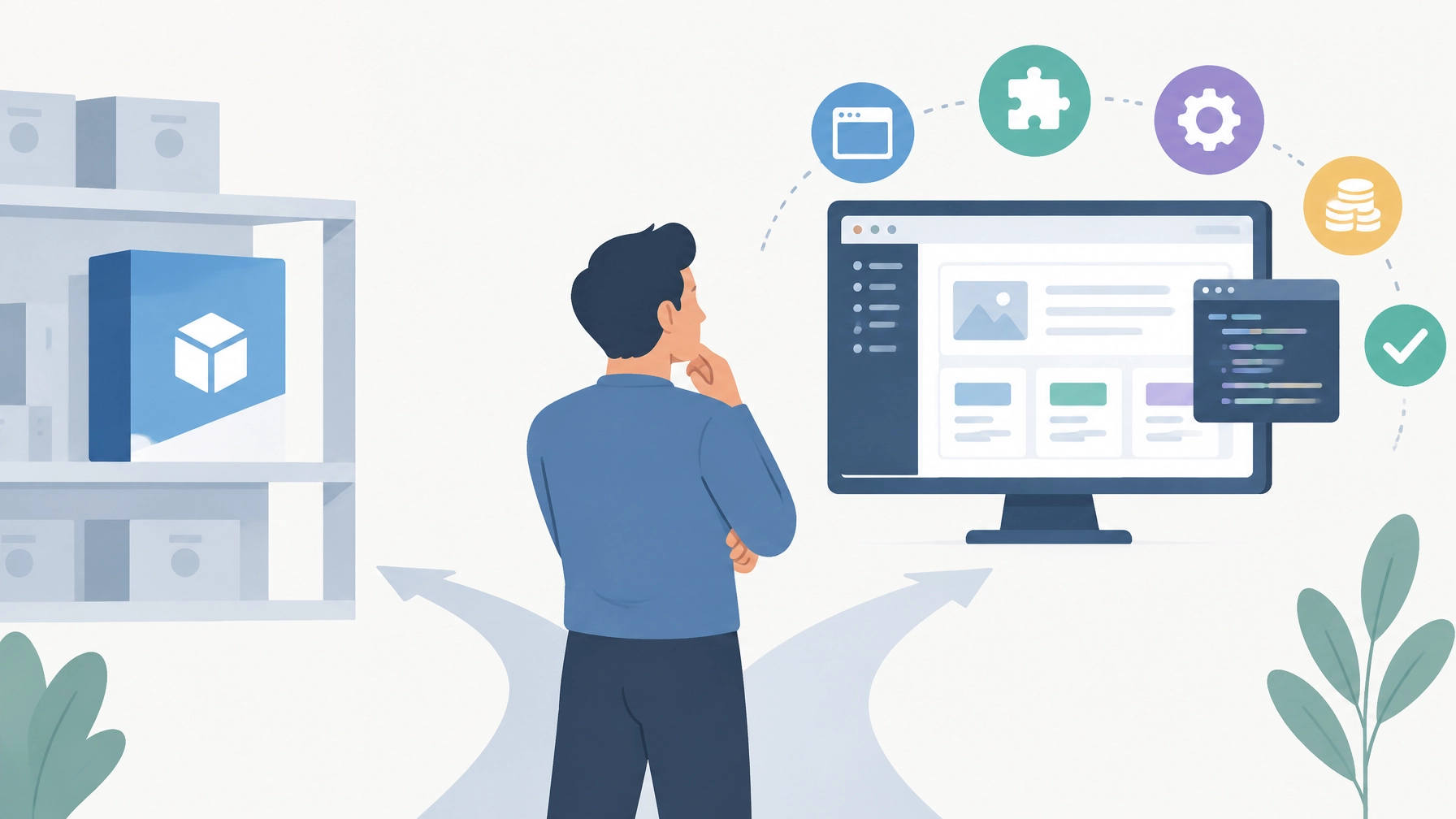
The choice between off-the-shelf software and custom web application development is not simply a comparison between a subscription and a development invoice. It is a decision about how your business works, where time is being lost, and how much control you need over your systems.
Off-the-shelf software usually costs less at the beginning. A custom web app usually requires more planning and investment upfront. However, a bespoke application can become more cost-effective when it removes manual work, reduces software duplication, improves efficiency and supports growth without continually adding licences.
The right answer depends on your workflows, users, integrations and long-term objectives.
The real cost is total cost of ownership
A fair comparison must look beyond the initial price. Total cost of ownership includes every direct and indirect cost associated with operating a system.
Consider the following:
- Licences or development costs
- Configuration and implementation
- Integrations and data migration
- Hosting and infrastructure
- Support, maintenance and upgrades
- Training and onboarding
- Manual work caused by system limitations
- Additional tools and add-ons
- Data export and switching costs
An off-the-shelf platform may appear inexpensive because the cost is spread across monthly payments. A custom application may appear expensive because much of the investment is visible at the start.
Neither figure tells the full story.
Off-the-shelf software: the advantages and limitations
Off-the-shelf software is built for a broad market. It typically provides a set of standard functions that can be configured to suit different organisations.
Pros
- Lower initial cost
- Faster implementation
- Established user interface and documentation
- Vendor-managed hosting, updates and core security
- Access to existing integrations and support resources
- Suitable for common, well-understood business processes
Cons
- You may pay for features that are irrelevant to your business
- Your team may need to adapt its processes to the platform
- Advanced functionality may require premium plans or paid modules
- Integrations can introduce recurring costs and additional failure points
- Vendor price increases can affect future budgets
- Changes to the vendor’s roadmap are outside your control
- Data and functionality may be difficult to migrate later
What you should use it for
Off-the-shelf software is often the sensible choice when your requirements are standard, your team is small, and you need to start quickly.
For example, a growing business may not need a custom accounting platform. A reliable existing product is likely to handle invoicing, reporting and tax-related workflows more efficiently than building those functions from scratch.
The problem starts when a general-purpose platform becomes central to a process that is unique to your business.
Custom web applications: the advantages and limitations
Custom web application development creates software around your organisation’s specific processes, data and users.
The application may be an internal operations platform, a customer portal, a booking system, a workflow dashboard or a web-based product that supports your commercial model.
Pros
- Built around your actual workflows
- No need to pay for irrelevant functionality
- Greater control over integrations and data flows
- Easier to create role-specific user experiences
- Can reduce duplicate entry and manual administration
- More control over future priorities and development
- Can provide a competitive advantage through proprietary processes
- Scales with your users, data and operational requirements
Cons
- Higher initial investment
- Requires proper discovery and requirements planning
- You remain responsible for maintenance and improvements
- Poorly managed scope can increase cost and delay delivery
- You need a dependable technical partner or internal development capability
- Security, hosting, backups and monitoring must be planned carefully
What you should use it for
A custom web application is more likely to deliver value when your business has complex workflows, several systems that need to work together, or a significant amount of repetitive administration.
It is also appropriate when the software itself is part of your customer experience or competitive differentiation. If the way you manage enquiries, allocate work, provide services or deliver information is central to your business, a generic platform may limit future growth.
A practical cost and benefit example
Consider a service business with 15 staff members.
It currently pays:
- £300 per month for a core software platform
- £150 per month for additional modules and integrations
- £6,000 for initial configuration and data migration
Over five years, the direct cost would be:
- Core subscription: £18,000
- Add-ons and integrations: £9,000
- Initial implementation: £6,000
- Total: £33,000
That figure does not include manual work. If the platform causes each employee to spend just two hours per week exporting data, checking records or updating another system, the opportunity cost can become substantial.
Now compare that with an illustrative custom application:
- Initial discovery, design and development: £35,000
- Hosting, maintenance and support: £600 per month
- Five-year direct cost: £71,000
At first glance, the custom application appears more than twice as expensive. However, if it removes five hours of administrative work per employee each week, the business may recover considerably more productive capacity over the same period.
This is not a guaranteed saving or a universal market estimate. It is a model for thinking about the decision. Your calculation should use your own staff costs, software quotations, time spent on workarounds, user numbers and expected growth.
The key question is not:
“Which option has the lowest purchase price?”
It is:
“Which option creates the lowest cost for delivering this business process over its useful life?”
Where off-the-shelf costs can increase
The most common hidden costs are not always obvious during procurement.
Unused functionality
A platform may include dozens of features, but your business may rely on only a small proportion of them. You are effectively funding a broad product when you need a focused tool.
Additional users
Per-user pricing can become increasingly expensive as your team grows. Temporary users, contractors and external partners may also require additional licences.
Premium modules
Functions such as advanced reporting, automation, permissions or API access may be restricted to higher pricing tiers.
Workarounds
Workarounds often involve spreadsheets, manual exports, duplicate data entry and informal processes. These create operational overhead and increase the chance of mistakes.
Integration dependency
Connecting several platforms may require middleware, paid connectors or custom scripts. Each additional system introduces another dependency to monitor and maintain.
Switching costs
If the platform no longer suits your business, moving away may involve data cleansing, migration, retraining and rebuilding integrations.
Where custom application costs can increase
Custom software is not automatically cheaper. It must be managed as a long-term digital asset.
The most significant risks include:
- Starting development before the business problem is clearly defined
- Adding features without reviewing their business value
- Designing for current requirements without considering future users or data
- Selecting technology that is difficult to maintain
- Failing to document the architecture and deployment process
- Treating security and testing as late-stage activities
A controlled discovery phase is therefore essential. Before development begins, you should understand which process the application will improve, who will use it, what systems it must connect to and how success will be measured.

Security, privacy and ownership
Both approaches carry security and privacy responsibilities.
With off-the-shelf software, you must assess the vendor’s security controls, data processing arrangements, access permissions, hosting locations, backup policies and incident response processes. You should also understand what happens to your data if the supplier changes its service or closes your account.
With custom software, you have more control over the architecture and data flows, but you also carry greater responsibility for secure development, dependency management, access control, monitoring, updates and testing.
The National Institute of Standards and Technology’s software supply chain guidance is useful when assessing both custom and commercial software. Its recommendations reinforce the importance of understanding third-party components, secure development practices and supplier risk.
Privacy should be considered during architecture and design, not added after launch. Data minimisation, appropriate retention, role-based access and audit trails should reflect the information your business actually needs to process.
When should you choose custom web application development?
Custom development is worth serious consideration when several of the following statements apply:
- Your team relies on spreadsheets to compensate for software limitations.
- Staff repeatedly enter the same information into multiple systems.
- Your processes are different from those supported by standard platforms.
- You need several systems to share data reliably.
- Your software costs increase as your team grows.
- Your customer experience depends on a tailored digital journey.
- You expect the process to become more complex over the next three to five years.
- The business would benefit from dashboards, permissions or automation designed around specific roles.
- The software could become a valuable business asset or differentiator.
If only one or two apply, configuration or process improvement may be enough. If most apply, continuing to add subscriptions and workarounds may be less economical than creating a focused application.
How TeqFlo approaches bespoke app building
TeqFlo brings 14 years of experience in web development, software development and app development. That engineering foundation informs how we approach custom web application development today.
We begin with discovery rather than technology selection. The objective is to identify the real operational problem, remove unnecessary complexity and define a solution that can evolve.
Our process includes:
- Discovery: Understand business objectives, users, bottlenecks and constraints.
- Planning: Define the product scope, integrations, technical approach and delivery roadmap.
- Design: Create accessible, user-focused interfaces for the people who will use the application.
- Development: Build secure, maintainable and scalable software.
- Testing: Validate functionality, performance and reliability through structured testing.
- Launch and support: Deploy the application carefully and provide ongoing maintenance.
You can explore TeqFlo’s custom app and software development service or learn more about bespoke web development.
The decision: buy, build or combine?
The choice does not always have to be entirely one or the other.
A practical strategy may be to retain reliable off-the-shelf tools for standard functions while building a custom application for the process that creates the most cost, friction or competitive value.
For example, you could retain your accounting platform and email service while introducing a bespoke operations portal that connects them. This avoids rebuilding commodity functionality while giving your team a system designed around its core workflow.
The best investment is usually the one that matches the level of uniqueness in the problem.
If your business process is standard, buy. If it is strategically important, operationally inefficient and poorly served by existing tools, build. If the answer is unclear, begin with a structured discovery exercise and a total-cost-of-ownership comparison.
That approach replaces guesswork with a decision based on measurable business value.
Discuss your requirements with TeqFlo to assess whether custom web application development is the right route for your business.
Frequently asked questions
Is custom web application development always more expensive?
No. It normally requires a higher upfront investment, but it may reduce recurring licences, manual administration, integration costs and future switching costs. The outcome depends on the application’s scope and the value of the process it improves.
How do I calculate whether a custom app will save money?
Compare five-year total cost of ownership. Include subscriptions, add-ons, implementation, integrations, training, maintenance, hosting and staff time spent on workarounds. Then estimate the operational value created by the custom application.
Can a custom web app integrate with existing software?
Yes. Integrations can be planned around your existing CRM, accounting system, databases, identity provider and other business tools. The exact approach depends on the APIs, data structures and security requirements involved.
How long does a custom application take to build?
The timeline depends on complexity, integrations, user roles and testing requirements. TeqFlo states that most of its software and app projects are delivered within 8–16 weeks, subject to requirements and scope.
What if I need standard software as well as a custom application?
A combined approach is often practical. Keep off-the-shelf software for standard tasks and use custom development where your processes require more flexibility or where workarounds are creating measurable cost.
Leave a Reply